Twitter has updated its developer rules to ban third-party clients, almost a week after it unceremoniously blocked the apps’ access to its platform, offering almost no explanation to what was going on (via Engadget). The new rules state that you can’t use Twitter’s API or content to “create or attempt to create a substitute or similar service or product to the Twitter Applications.”
Craig Hockenberry, principal at Iconfactory, put it more bluntly on his personal blog: “There was no advance notice for its creators, customers just got a weird error, and no one is explaining what’s going on. We had no chance to thank customers who have been with us for over a decade. Instead, it’s just another scene in their ongoing shit show.”
Microsoft has been reportedly experimenting with building OpenAI’s language AI technology into its Word, PowerPoint, and Outlook apps. The Information reports that Microsoft has already incorporated an unknown version of OpenAI’s text-generating GPT model into Word in its autocomplete feature, and has been working on integrating it further into Word, PowerPoint, and Outlook.
While 3G will still exist in other countries for quite a few more years, Verizon’s deadline is pretty much the end of the line for it here in the US. The tech hasn’t gone gentle into that good night; carriers delayed their shutdowns several times, there were tiffs between Dish and T-Mobile, and you can’t just turn a network that had been around for years off without things starting to break.
Twitter will no longer allow users to promote their presence on certain social platforms, including Facebook, Instagram, Mastodon, Truth Social, Tribel, Nostr, and Post. In a post outlining these changes, Twitter says it will take action against users that violate this policy “at both the Tweet level and the account level.”
A close-up image of a silicon mono-crystal. Silicon is a crucial component in AI. Image: Catherine Breslin / Better Images of AI / Silicon Closeup / CC-BY 4.0
Capability overhang is a technical term, but it also perfectly describes what’s happening right now as AI enters the public domain. For years, researchers have been on a tear, pumping out new models faster than they can be commercialized. But in 2022, a glut of new apps and programs have suddenly made these skills available to a general audience, and in 2023, as we continue scaling this new territory, things will start changing — fast.
The problem is, the Quest Pro isn’t very good. It’s a device seemingly launched without plan or purpose, highlighting VR’s persistent drawbacks without making good use of its strengths — and topped off with some irredeemably bad software. We might be seeing a roadmap for where Meta is going, but right now, it’s not a particularly fun place to be. And if Meta lingers there much longer, its metaverse is in trouble.
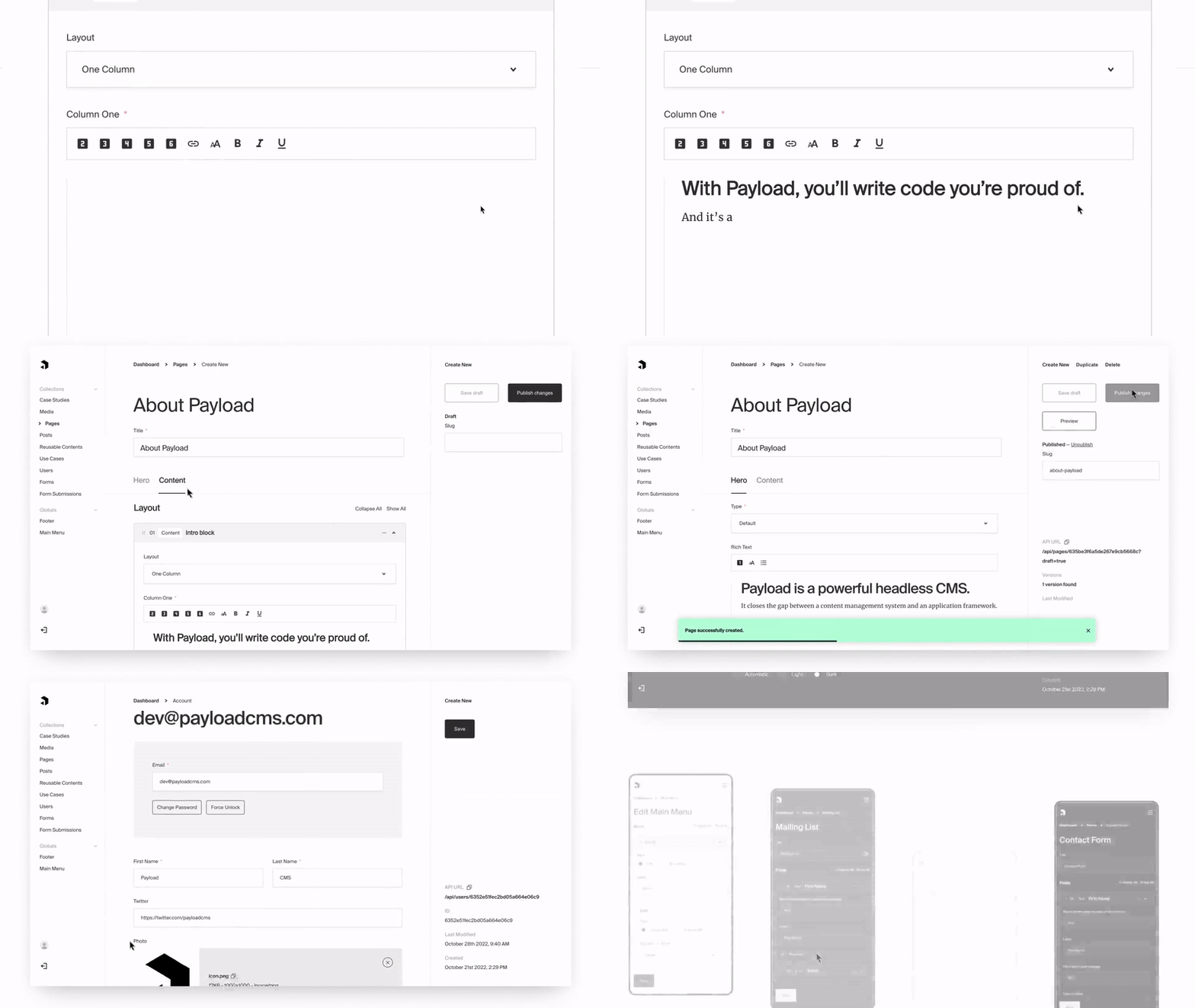
Instead of building another no-code CMS, the team went in the exact opposite direction and built something more akin to a framework than “just” a pure headless CMS. To get started, developers describe their configuration for Payload in TypeScript and the service creates a Mongo database, sets up REST and GraphQL APIs, handles file storage, authentication and access control, and, of course, creates the admin UI, which defaults to a clean, minimalist look.
:format(webp)/cdn.vox-cdn.com/uploads/chorus_asset/file/23926015/acastro_STK050_06.jpg)
:format(webp)/cdn.vox-cdn.com/uploads/chorus_asset/file/10793349/acastro_180507_1777_microsoft_0002.jpg)
:format(webp)/cdn.vox-cdn.com/uploads/chorus_asset/file/13912402/3G.1419965040.jpg)
/cdn.vox-cdn.com/uploads/chorus_asset/file/23951433/acastro_STK050_07.jpg)
:format(webp)/cdn.vox-cdn.com/uploads/chorus_asset/file/24275829/CatherineBreslin_SiliconCloseup_2650x1767.jpg)