Canva is launching its latest smorgasbord of generative AI-powered workspace tools in its attempt to cram everything that Microsoft, Google, and Adobe can do into a single platform. Canva’s Visual Suite is being redesigned to combine its design and productivity tools into a single interface, alongside adding new coding, photo editing, spreadsheet, and AI chatbot features.
After years of teasing, Samsung is finally gearing up to launch its Ballie robot “this Summer,” with the company teaming up with Google to leverage Gemini on the helpful home robot. Samsung first showed off Ballie in early 2020, but the project has been delayed and reimagined in the years since. At CES 2024, the company showed off the updated design of Ballie, and has now committed to a “Summer” 2025 release.
Generative Extend is completely free to use for a “limited time,” according to Adobe, after which the feature will require users to spend Firefly generative credits. Creative Cloud subscriptions provide a monthly allocation of credits ranging between 25 to 1,000 credits depending on the plan. An additional Firefly credit subscription is also available starting from $10, which grants 2,000 credits per month. Adobe has not specified how many credits the Generative Extend feature will eventually consume, but says that “price will vary based on the format, frame rate, and resolution of your video.”
On Tuesday, OpenAI announced new multimodal image-generation capabilities that are directly integrated into its GPT-4o AI language model, making it the default image generator within the ChatGPT interface. The integration, called "4o Image Generation" (which we'll call "4o IG" for short), allows the model to follow prompts more accurately (with better text rendering than DALL-E 3) and respond to chat context for image modification instructions. Some users on social media initially reported confusion since there's no UI indication of which image generator is active, but you'll know it's the new model if the generation is ultra slow and proceeds from top to bottom. The previous DALL-E model remains available through a dedicated "DALL-E GPT" interface, while API access to GPT-4o image generation is expected within weeks.
A new study examining meme creation found that AI-generated meme captions on existing famous meme images scored higher on average for humor, creativity, and "shareability" than those made by people. Even so, people still created the most exceptional individual examples. "I regret to announce that the meme Turing Test has been passed," wrote Wharton professor Ethan Mollick on Bluesky after reviewing the study results. Mollick studies AI academically, and he's referring to a famous test proposed by computing pioneer Alan Turing in 1950 that seeks to determine whether humans can distinguish between AI outputs and human-created content.
“The conversion gap reinforces that AI is being utilized during the research and consideration stage, in advance of when shoppers are ready to hit the buy button.” But, it added, the closing gap “shows that consumers are also increasingly comfortable completing a transaction directly after an AI-powered chat experience.”
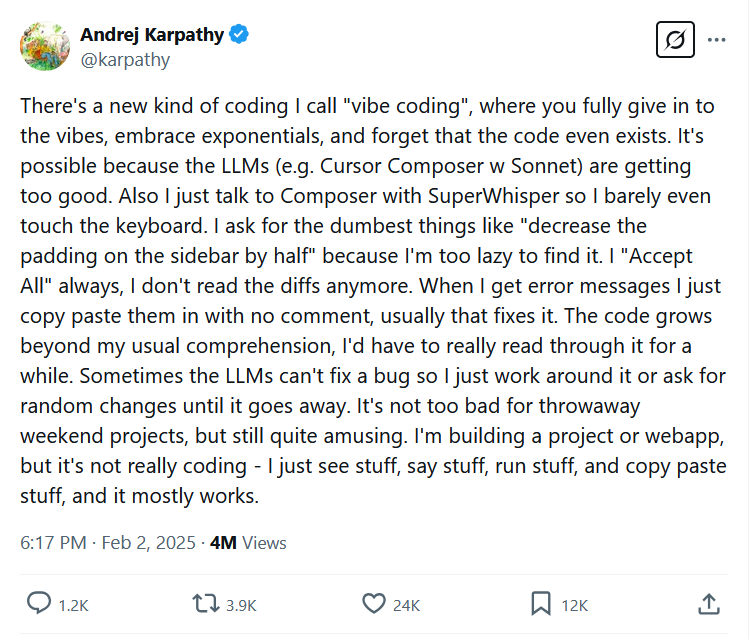
Instead of being about control and precision, vibe coding is all about surrendering to the flow. On February 2, Karpathy introduced the term in a post on X, writing, "There's a new kind of coding I call 'vibe coding,' where you fully give in to the vibes, embrace exponentials, and forget that the code even exists." He described the process in deliberately casual terms: "I just see stuff, say stuff, run stuff, and copy paste stuff, and it mostly works."